1. Research Background
In an era marked by the convergence of the knowledge economy and digital transformation, innovation stands as the cornerstone for enterprises to achieve sustainable competitive advantage. For technology-based enterprises, which inherently center on product research and development, technological innovation, and business model renewal, innovation constitutes the very essence that defines them as technology-driven firms (Wang, 2025). In the fiercely competitive environment where "the fast fish devours the slow," the continuous shortening of product life cycles, frequent talent turnover, and rising innovation costs all necessitate that enterprises be capable of stimulating employees' creative potential amidst high-pressure and rapidly changing circumstances (Lu & Zhang, 2007). How to effectively stimulate and manage employees' creative behaviors has emerged as the top priority challenge that corporate leaders urgently need to address. The limitations of traditional leadership styles and theories have become increasingly apparent. For instance, transformational leadership, which was highly regarded during the industrial era, emphasizes that leaders inspire employees through vision, role modeling, and motivation to achieve performance beyond expectations (Bass, 1985). However, employees in technology-based enterprises are characterized by high educational attainment, advanced skills, and strong autonomous motivation. They tend to prefer flat and open management models, and their individual needs and innovation aspirations sometimes struggle to resonate with the grand transformative visions of the enterprise. In contrast, authoritarian and task-oriented leadership styles, which lean towards strict control and lack of empowerment, tend to stifle employees' creative initiative and courage to experiment and make mistakes. To empower employees in creative enterprises to engage in unrestrained creativity and bold trial-and-error exploration, it is imperative for companies to foster an innovation-supportive environment, which precisely necessitates a fundamental transformation in leadership models. Technology enterprises urgently require a novel leadership model that can balance trust, support, and psychological safety, so as to unleash employees' intrinsic creative motivation. Inclusive leadership, characterized by its core attributes of openness, accessibility, and usability, along with its acceptance of diverse employee voices, support for creative exploration, and tolerance for failure, exhibits a high degree of alignment with the culture of technological innovation. Consequently, it has garnered widespread attention from both academic and practical circles. However, with the substantial shortening of technological iteration cycles, employees are not only required to continuously grapple with an endless stream of emerging technological tools but also endure profound career anxiety stemming from the obsolescence of their skills and the threat of being replaced by technology. In this persistently high-pressure technological context, the positive effects of inclusive leadership may be subtly diluted and systematically undermined by technological stress.
Based on this, this paper centers its discussion around the core question of "through what mechanisms does technostress undermine the positive influence of inclusive leadership on employees' creative behaviors," aiming to deepen theoretical understanding of the efficacy boundaries of inclusive leadership and provide valuable references for the management practices of technology-based enterprises.
From the perspective of Social Cognitive Theory (Bandura, 1986), inclusive leadership can enhance employees' creative self-efficacy through a threefold mechanism comprising "modeling by example - verbal persuasion - successful experiences," thereby empowering employees to generate, promote, and implement new ideas with greater confidence when confronted with challenges (Gong et al., 2009). Creative self-efficacy refers to employees' belief in their own creative capabilities and serves as a crucial psychological bridge linking leadership behaviors to creative actions. Employees with high levels of creative self-efficacy are more inclined to select challenging creative tasks, demonstrate greater perseverance when encountering difficulties, and cope more effectively with setbacks (Tierney & Farmer, 2011). Employees with high levels of creative self-efficacy are more inclined to take on creative risks, overcome obstacles, and sustain long-term engagement in creative activities (Jaiswal & Dhar, 2015). Existing empirical research has demonstrated that trust, support, and respect from leaders towards employees can enhance employees' affective commitment and motivation, thereby boosting their self-efficacy and, consequently, strengthening their creative motivation. Inclusive leadership, characterized by its emphasis on respecting employees, delegation of authority, and empowerment, can significantly enhance employees' self-efficacy. Technostress refers to the negative psychological state experienced by employees when using new technologies, stemming from factors such as technological complexity, information overload, and system intrusions (Tarafdar et al., 2007). Technostress not only diminishes employees' work efficiency and well-being (Ayyagari et al., 2011) but also undermines their creative motivation and creativity (Ragu-Nathan et al., 2008). By disrupting individuals' self-regulation and the allocation of cognitive resources, technostress inhibits the formation of creative self-efficacy. Consequently, technostress may serve as a critical contextual boundary condition that moderates the influence of inclusive leadership on employees' creative behaviors.
Therefore, this study focuses on the unique human resource management context faced by technology enterprises and constructs a comprehensive theoretical model. It explores the mechanisms through which inclusive leadership influences employees' creative behaviors, establishing a mediating pathway via creative self-efficacy. Additionally, it introduces technostress as a moderating variable to examine its boundary effects. Grounded in Social Cognitive Theory, the study formulates research hypotheses and employs empirical analysis methods for validation, aiming to assist technology enterprises in continuously enhancing their core competitiveness and achieving sustainable development.
2. Theoretical Foundations and Research Hypotheses
2.1 Inclusive Leadership and Employee Creative Behavior
Inclusive leadership emphasizes that leaders should demonstrate openness, accessibility, and availability, while providing employees with respect, support, tolerance, and empowerment (Randel et al., 2018). These attributes align closely with the psychological and environmental conditions necessary for fostering creative behavior.
Inclusive leadership behaviors are perceived by employees as a significant form of social reward. When leaders use their inclusive actions to make employees feel valued, trusted, and accepted, it triggers a strong sense of reciprocal obligation among employees. This, in turn, motivates them to voluntarily engage in behaviors that extend beyond their formal job responsibilities. Creative behavior stands out as a crucial manifestation of such voluntary contributions that surpass existing role requirements. He (2021) argued that inclusive leadership exerts a positive influence on employees' proactive creative behaviors through two pathways: work thriving and perceived organizational status. The error management climate serves as a moderator in this process. Furthermore, he emphasized that inclusive leadership stimulates creative behaviors by enhancing psychological states and status perception, with such stimulation being more pronounced in a favorable organizational climate. Liu (2023) found in her research that inclusive leadership exhibits a significant positive correlation with employees' creative behaviors. The error management climate plays either a mediating or moderating role between the two. Specifically, under conditions of a favorable error management climate, inclusive leadership more effectively promotes creative behaviors among knowledge workers. This finding underscores the synergistic enhancement of creative behaviors through the combined influence of organizational climate and inclusive leadership. Carmeli (2010) pointed out that inclusive leadership is characterized by openness, accessibility, and availability. Such a leadership style facilitates employees' participation in creative tasks and enhances their creative performance, thereby illustrating the mechanistic link between the behavioral traits of inclusive leadership and employees' creative behaviors.
Therefore, inclusive leadership, grounded in reciprocal relationships, facilitated through positive role modeling, and supported by addressing employees' psychological needs, lays a solid foundation for fostering creative behaviors among employees. In technology-oriented enterprises, where high autonomy and innovation-driven work inherently involve uncertainties, inclusive leadership effectively responds to such challenges and is more conducive to stimulating the emergence of creative behaviors.
Based on this, the present study proposes the following hypotheses:
Hypothesis 1: Inclusive leadership exerts a positive influence on employees' creative behaviors.
2.2 The Mediating Role of Creative Self-Efficacy
According to Social Cognitive Theory, an individual's self-efficacy is not static but is shaped through multiple pathways, with social environments and role models playing particularly significant roles (Bandura, 1986). Inclusive leadership does not operate through a single pathway; instead, it systematically and multidimensionally enhances employees' creative self-efficacy by employing mechanisms outlined in Social Cognitive Theory, such as verbal persuasion, improving emotional states, and providing firsthand experiences. Wu Shijian et al. (2020) noted that within the framework of a harmonious culture, inclusive leadership strengthens employees' positive self-assessment of their creative capabilities by cultivating an open and inclusive organizational climate and affirming employees' individuality and creative endeavors. This process emboldens employees to take initiative and mitigates their fear of failure, thereby enhancing their confidence in achieving success in creative tasks—a concept referred to as creative self-efficacy. Yao and Li (2014) argued that the respectful, supportive, and accepting behaviors exhibited by inclusive leaders can enhance employees' psychological safety and emotional stability. Additionally, leaders' open communication and non-punitive attitudes inspire employees' confidence to innovate boldly, thereby strengthening their creative self-efficacy. He (2021) pointed out that the empowering behaviors and supportive policies of inclusive leaders can enhance employees' psychological empowerment and sense of competence. Through this empowerment process, leaders bolster employees' confidence in "taking control of innovation," thereby fostering sustained creative motivation.
A high level of creative self-efficacy can elevate employees' intrinsic motivation in creative activities, leading them to become more emotionally engaged in the innovation process and willing to persistently overcome difficulties and keep trying. Gu and Peng (2019), from the perspective of social support, posited that when individuals believe they possess the capabilities required for innovation, they are more inclined to proactively identify problems, generate novel ideas, and derive reinforcing effects from social support. Consequently, creative self-efficacy serves as a psychological turning point that transitions individuals from "passive responsiveness" to "proactive innovation." Wang (2020), using knowledge workers in the digital context as her research sample, discovered that high-performing individuals are better at mobilizing their intrinsic interest and maintaining focus and enthusiasm for tasks, thereby enabling sustained creative exploration. Creative self-efficacy helps employees accurately evaluate challenges and resources, sustain confidence and resilience, and demonstrate greater persistence and frustration tolerance throughout the innovation process. Wang et al. (2021) argued that individuals with high levels of creative self-efficacy possess stronger beliefs in their own creative capabilities, enabling them to maintain positive cognitive appraisals when confronted with failure and uncertainty. This, in turn, allows them to demonstrate greater cognitive flexibility and problem-solving abilities. Xin (2023) posited that high-performing teachers exhibit greater adaptability and persistence when confronted with complex technological tasks, which can help employees maintain cognitive stability and refrain from giving up easily in the face of innovation failures. Leadership behavior does not directly elicit creative behavior from employees; rather, it exerts its influence indirectly by shaping employees' intrinsic psychological cognitions. Individuals internalize their perceptions of the external environment into beliefs about their own capabilities, ultimately driving their behavioral outcomes. Self-efficacy serves as the most pivotal psychological mechanism in this process (Bandura, 1986).
Employees with high levels of creative self-efficacy consistently believe in their ability to tackle challenges and risks encountered during the innovation process. Consequently, they exhibit a stronger inclination towards innovation and demonstrate greater perseverance and endurance when confronted with setbacks (Tierney & Farmer, 2011). This unwavering belief in one's own creative capabilities serves as a potent catalyst in facilitating employees' transformation of their creative potential into tangible creative actions, permeating the entire process from idea generation and promotion to implementation (Scott & Bruce, 1994). Therefore, creative self-efficacy serves as a crucial intermediary link between inclusive leadership and employees' creative behavior. It not only represents the outcome of the positive influence of inclusive leadership but also functions as a precursor that drives employees' creative actions. When leaders demonstrate inclusiveness, employees' creative self-efficacy experiences an enhancement. It is precisely this heightened sense of self-efficacy that ultimately motivates employees to engage in creative behaviors. This mechanism unveils the intrinsic "black box" process through which inclusive leadership influences innovation, thereby providing a more comprehensive and in-depth theoretical explanation.
Based on this, the present study puts forward the following hypothesis:
Hypothesis 2: Creative self-efficacy plays a mediating role in the mechanism through which inclusive leadership influences employees' creative behavior.
2.3 The Moderating Role of Technostress
According to Social Cognitive Theory, self-efficacy has four primary sources: enactive mastery, vicarious experience, verbal persuasion, and physiological and affective states (Bandura, 1997). However, with the widespread adoption of information technology and the accelerated pace of digital transformation, technostress interferes with individuals' processing of external positive information by depleting their cognitive and emotional resources, thereby hindering the formation of self-efficacy (Shu et al., 2011). Xin (2023) argues that technostress undermines teachers' technological self-efficacy, with the emotional anxiety and physical and mental exhaustion induced by technostress significantly diminishing teachers' performance in teaching. Yan (2022) pointed out that when employees are confronted with high-intensity technological changes and informational pressures, counterproductive work behaviors may still emerge despite the ample resource support and encouragement provided by leaders, due to the depletion of psychological resources. Yang and Feng (2024) found that technostress can lead to issues such as attention distraction and emotional exhaustion among employees, thereby diminishing the positive impact of leadership support on employee performance outcomes. Wang et al. (2025) pointed out that the technostress arising from technological complexity and information overload significantly elevates employees' cognitive load, thereby further undermining their learning and reflective capabilities. Therefore, when technostress is high, employees may perceive external support provided by the organization as an additional burden and might even avoid the resources and support offered by the organization due to perceived technological threats, thereby weakening the positive psychological efficacy generated by leaders' inclusive behaviors. Conversely, in contexts characterized by low technostress, employees possess more abundant psychological and attentional resources, enabling them to fully absorb positive signals from leaders. Through the processes of modeling and verbal persuasion, they undergo an internalization of self-belief (Salanova et al., 2013). In such scenarios, the supportive role of inclusive leadership is more likely to facilitate the enhancement of creative self-efficacy via the pathway of "verbal persuasion" (Gu, 2016).
According to Social Cognitive Theory, the occurrence of behavior relies not solely on self-efficacy (belief) but is also influenced by situational support and barriers (Bandura, 1997). Technostress represents a significant environmental barrier that depletes employees' cognitive and emotional resources. When confronted with technological complexity, information overload, and technological encroachment, employees' attentional resources become severely taxed, leading to negative impacts on their physiological and emotional states. Consequently, this diminishes their perception and absorption of external supportive cues, such as leadership encouragement (Tarafdar et al., 2007). This disruption shatters the "efficacy formation chain" established during employees' social cognitive processes, making it difficult for the verbal persuasion and modeling demonstrated by inclusive leaders to be internalized into stable efficacy beliefs (Califf et al., 2020). Zhang et al. (2023) argued that technological anxiety can disrupt immersive experiences, preventing individuals from maintaining sustained focus on their goals. Feng et al. (2023) discovered that technostress indirectly undermines teachers' creative performance by reducing their flow experience. Wang et al. (2025) posited that, under conditions of excessive cognitive load, the positive impact of creative self-efficacy is supplanted by "task interference." Yang and Feng (2024) argued that technostress diminishes the positive emotions derived from social media use, suggesting that technostress disrupts sustained pleasurable engagement. Under high technostress, employees tend to allocate more attention to coping with technological challenges rather than developing creative capabilities. This, in turn, diminishes the mediating effect of inclusive leadership in fostering creative behavior through creative self-efficacy. Technostress elevates both the implementation and failure costs associated with creative behavior, thereby weakening the predictive power of self-efficacy on behavior. Under conditions of low technostress, employees possess more abundant psychological resources and exhibit a more positive emotional state, perceiving relatively lower environmental risks and fewer implementation barriers. Consequently, creative self-efficacy can more effectively motivate employees to engage in creative behaviors.
Therefore, this study proposes the following hypotheses:
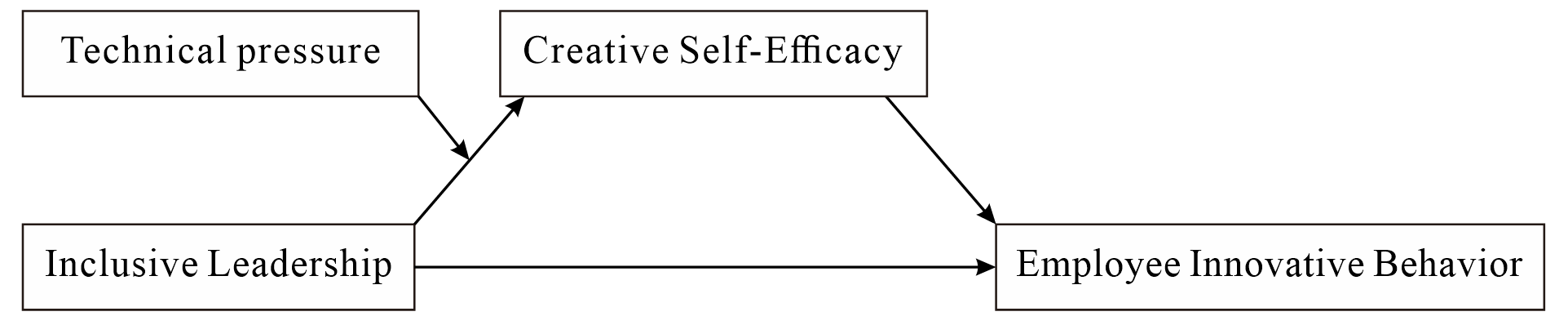
Hypothesis 3: Technology moderates the mediating relationship between creative self-efficacy and the impact of inclusive leadership on employees' creative behaviors. Specifically, as technostress increases, the influence of inclusive leadership on employees' creative behaviors through creative self-efficacy becomes weaker.
Figure 1
Research model
3. Research Methodology and Data Analysis
3.1 Survey Participants and Procedure
The survey sample for this study was drawn from 13 technology-based enterprises, encompassing a range of businesses including internet companies, artificial intelligence development and application firms, computer development and service providers, as well as biotechnology and pharmaceutical industries. Convenience sampling was employed, without imposing controls on the gender or age of participating employees. During the sample selection process, efforts were made to ensure the diversity of the sample. The online survey platform, Questionnaire Star, was utilized for questionnaire distribution.
A total of 680 questionnaires were collected, and after sorting and cleaning, 553 valid questionnaires were retained. In terms of gender distribution, males accounted for a substantial proportion of 77.94%, while females constituted 40.33%. From the perspective of age characteristics, individuals aged 25 and under accounted for 14.29% of the sample. The highest proportion was observed among those aged 26-30 (inclusive), at 31.28%, followed by those aged 31-40 (inclusive) at 34.18%. Those aged 41-50 (inclusive) constituted 17.72%, while those aged 51-60 (inclusive) made up 2.17%. Individuals aged 61 and above represented a mere 0.36% of the sample, indicating that young employees constituted the largest proportion. In terms of educational attainment, 36.17% of the sample held a junior college degree or below, 51.54% possessed a bachelor's degree, 9.40% had a master's degree, and 2.89% held a doctoral degree. Notably, over 60% of the sample had received an undergraduate education or higher. In terms of enterprise size, firms with fewer than 300 employees accounted for 47.74% of the sample, those with 300-1000 (inclusive) employees constituted 33.82%, those with 1000-3000 (inclusive) employees made up 10.49%, and enterprises with over 3000 employees represented 7.96%. Notably, small and medium-sized enterprises (SMEs) accounted for nearly 80% of the sample.
3.2 Variable Measurement
The scales employed in this study are well-established ones widely used in domestic and international academic circles. All of them adopt a 5-point Likert scale, where the responses range from 1 to 5, indicating a progression from "strongly disagree" to "strongly agree".
(1) Inclusive leadership was measured using a 9-item scale adapted from Randel et al. (2018). A sample item reads: "My supervisor is open to listening to new ideas from colleagues." In the present study, the Cronbach's α coefficient for this scale was 0.912.
(2) Employee creative behavior was measured using a 6-item scale developed by Scott and Bruce (1994). A sample item is: "I actively seek out and explore new technologies, processes, techniques, or product ideas." In the present study, the Cronbach's α for this scale was 0.779.
(3) Creative self-efficacy was measured using a 3-item scale developed by Tierney and Farmer (2011). A sample item is: "I am confident that I can solve problems creatively." In the present study, the Cronbach's α for this scale was 0.926.
(4) Technostress was measured using the Technostress Creators Scale (TCS) developed by Tarafdar et al. (2007). To capture the specific technostress experienced by employees in technology-driven enterprises, this study drew upon the empirical work of Tarafdar et al. (2007), Ragu-Nathan et al. (2008), and Califf and Brooks (2020), and measured technostress across two dimensions: techno-overload and techno-complexity. In the present study, the Cronbach's α for this scale was 0.876.
(5) Control variables included gender, age, educational background, firm ownership type, and company size. The coding was as follows: Gender was coded into two categories, with 1 representing male and 2 representing female. Age was coded into six categories: 1 = "25 and under," 2 = "26–30 (inclusive)," 3 = "31–40 (inclusive)," 4 = "41–50 (inclusive)," 5 = "51–60 (inclusive)," and 6 = "61 and above." Educational background was coded into four categories: 1 = "junior college and below," 2 = "bachelor's degree," 3 = "master's degree," and 4 = "doctoral degree." Firm size was classified into four categories: 1 = "fewer than 300 employees," 2 = "300–1,000 employees (inclusive)," 3 = "1,000–3,000 employees (inclusive)," and 4 = "more than 3,000 employees."
4. Data Analysis Results
4.1 Reliability and Validity Analysis
First, SPSS 26.0 and Amos 26.0 were employed to test the reliability and validity of the measurement model. Table 1 presents the standardized factor loadings, Cronbach's α, composite reliability (CR), and average variance extracted (AVE) for each construct. As shown in the table, all Cronbach's α and CR values exceeded the recommended threshold of 0.7, and all AVE values were above 0.5, indicating that the scales demonstrated satisfactory reliability and convergent validity.
Table 1
Reliability and Validity Analysis

4.2 Common Method Bias Test
The potential common method bias was statistically examined using Harman's single-factor test. Based on the results of the Exploratory Factor Analysis (EFA), four factors with eigenvalues greater than 1 were extracted from the unrotated exploratory factor analysis, with the first factor accounting for 28.83% of the total variance. Since this value fell below the 50% threshold, it can be concluded that the sample data in this study did not suffer from severe common method bias.
4.3 Descriptive Statistics and Correlation Analysis
This study employed SPSS 26.0 to conduct descriptive and correlational analyses on inclusive leadership, employee creative behavior, creative self-efficacy, and technostress. Specifically, the means, standard deviations, and inter-variable correlations of these constructs were computed and are presented in Table 2. The results indicated that employee creative behavior was significantly and positively correlated with inclusive leadership (r = 0.460, p < 0.01), creative self-efficacy (r = 0.519, p < 0.01), and technostress (r = 0.264, p < 0.01), with all correlations being moderate in magnitude. Inclusive leadership was significantly and positively correlated with creative self-efficacy (r = 0.509, p < 0.01) and technostress (r = 0.235, p < 0.01), with both correlations being moderate in strength. Creative self-efficacy was significantly and positively correlated with techno-stress (r = 0.373, p < 0.01), with the correlation being moderate in magnitude. These findings provide preliminary support for the hypotheses proposed in this study.
Table 2
Descriptive Statistics and Correlation Coefficientsᵃ
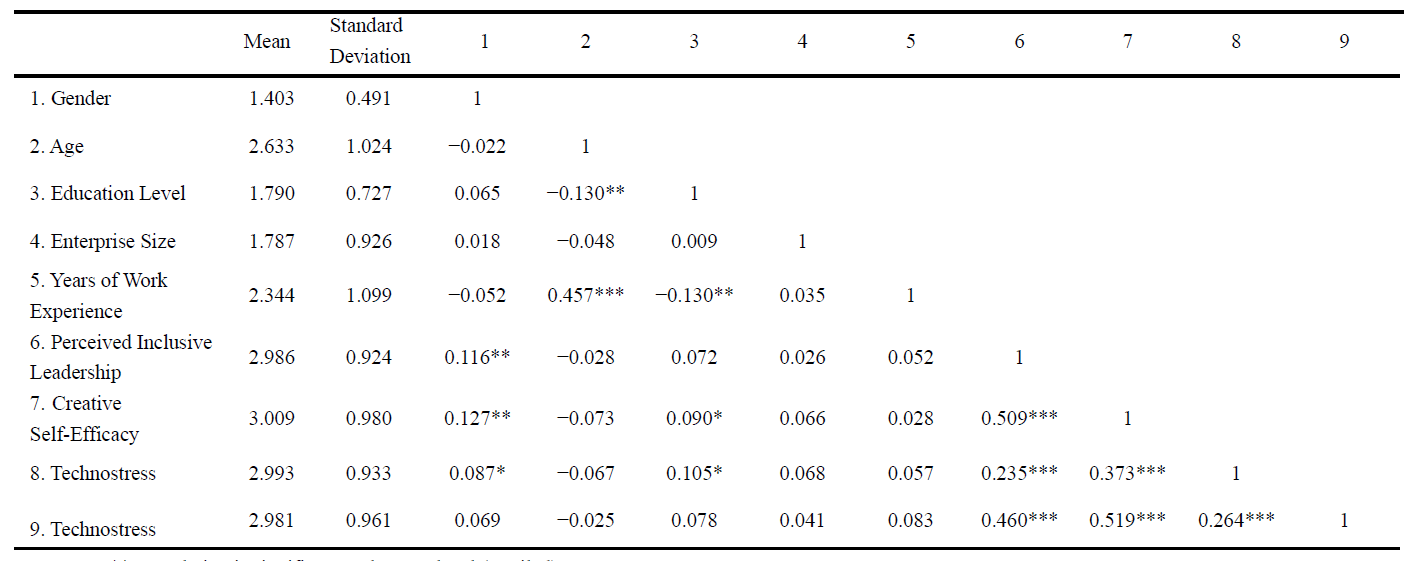
ᵃ n =398. ** Correlation is significant at the 0.01 level (2-tailed).
4.4 Hypothesis Testing
Given the hypotheses of this study, hierarchical regression analysis was employed to test the relationships among the variables. Models 1 and 6 were constructed with the control variables as independent variables and creative behavior and creative self-efficacy as dependent variables, respectively. This approach allowed for an examination of the independent effects of the control variables on the dependent variables. Subsequently, the main study variables were entered into the regression equations to assess their incremental explanatory power regarding the dependent variables. The results are presented in Table 3.
Main Effect Test. In Model 2, the independent variable inclusive leadership was added to Model 1 to establish the regression equation. The results of Model 2 indicate that inclusive leadership has a significant positive effect on employee creative behavior (β = 0.448, p < 0.001). Therefore, Hypothesis 1 is supported.
Table 3
Results of Regression Analysis
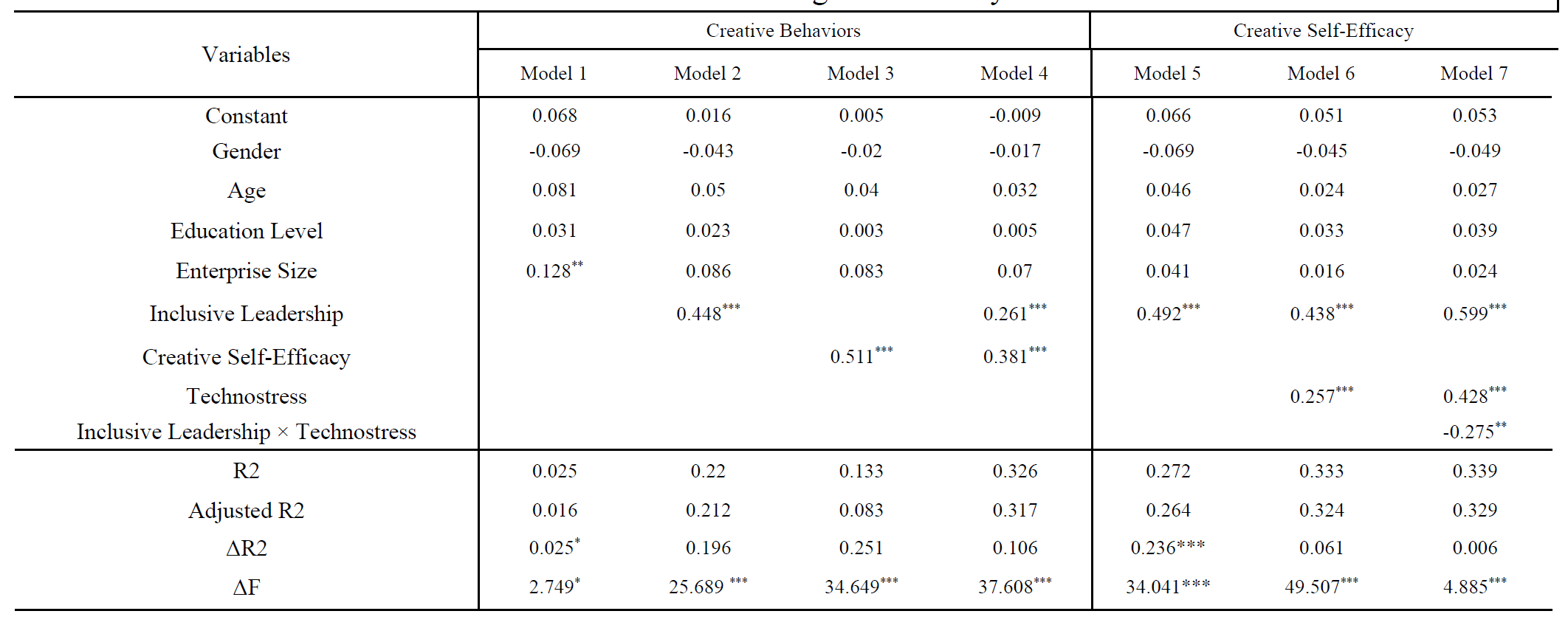
Mediation Effect Test. As indicated by Model 2 and Model 4, the inclusion of creative self-efficacy as a predictor yielded a statistically significant positive effect on employee creative behavior (β = 0.381, p < 0.001), while inclusive leadership continued to exert a significant positive influence on employee creative behavior (β = 0.261, p < 0.001). Notably, compared with Model 2, the regression coefficient for inclusive leadership declined from 0.448 to 0.261 upon the introduction of the mediating variable. This reduction in the direct effect suggests that creative self-efficacy serves as a partial mediator in the relationship between inclusive leadership and employee creative behavior. Additionally, the mediation effects were examined using a Bootstrap procedure in the present study, with the results presented in Table 4. Based on 5,000 resampled iterations, the indirect effect of creative self-efficacy was found to be 0.195, with a 95% bias-corrected confidence interval of [0.144, 0.251], which does not include zero. Based on these findings, it can be concluded that creative self-efficacy plays a partial mediating role in the relationship between inclusive leadership and employee creative behavior. Thus, Hypothesis 2 is supported.
Table 4
Results of Mediation Effect Test

Moderating Effect Test. To examine the moderating effect of technostress, Model 6 was constructed by adding technostress to the regression equation based on Model 5. Subsequently, Model 7 was established by incorporating the interaction term between the independent variable (inclusive leadership) and the moderator (technostress) into the regression equation. This procedure was conducted to test the moderating role of technostress in the relationship between inclusive leadership and creative self-efficacy. To mitigate multicollinearity, all variables were standardized prior to being entered into the models for analysis. As shown in Model 6, the significant ΔR2 indicates that technostress exerts a significant explanatory effect on creative self-efficacy. As shown in Model 7, the regression coefficient of the interaction term is significant (β=-0.275,p<0.001), and the regression coefficient of inclusive leadership is also significant (β=0.599,p<0.001). This indicates that technostress positively moderates the positive relationship between inclusive leadership and creative self-efficacy. Hypothesis 3 is supported. As illustrated in Figure 2, under conditions of high technostress, the positive effect of inclusive leadership on creative self-efficacy is attenuated.
Table 5
Mediation Effect Test Results

Test of the Moderated Mediation Effect. As posited in Hypothesis 3, technostress exerts a positive moderating effect on the relationship between inclusive leadership and creative self-efficacy. To further verify the validity of the moderated mediating effect, the PROCESS macro was adopted for subsequent analysis. With the number of bootstrap samples set to 5000, Model 7 of the PROCESS macro was employed to examine the moderated mediating effect of technological pressure at the 95% confidence interval level. As shown in Table 5, the 95% confidence interval (CI) for the low technological pressure group was [0.440, 0.643], which excluded zero; meanwhile, the 95% confidence interval (CI) for the high technological pressure group was [0.265, 0.484], also excluding zero. These results confirm the existence of the moderated mediating effect in the path of “inclusive leadership → creative self-efficacy”, thereby verifying Hypothesis 4.
Table 5
Mediation Effect Test Results

5. Discussion and Analysis
This study draws the following main research conclusions: (1) Empirical results demonstrate that inclusive leadership exerts a significant positive effect on employees' creative behavior in technology-based enterprises. This finding is highly consistent with existing literature, which further consolidates the theoretical foundation of inclusive leadership as an innovation-driven leadership style. (2) The mediating role of creative self-efficacy in the cognitive path. Based on Social Cognitive Theory, this study concludes that creative self-efficacy serves as a significant mediating factor in the relationship between inclusive leadership and employees' creative behavior. Furthermore, it reveals the psychological mechanism whereby inclusive leadership promotes employees' creative behavior through the cognitive dimension of “competence belief”. This finding provides an important cognitive perspective for understanding how leadership influences employee innovation. (3) The negative moderating effect of technological pressure. This study creatively takes technological pressure as a moderating variable and verifies its negative moderating effect on the relationships between inclusive leadership, creative self-efficacy, and work flow. This finding offers a contextual perspective for understanding the boundary conditions of leadership effectiveness in the digital era and clarifies how technological environmental factors shape the effectiveness of leadership.
The theoretical contributions of this study are mainly reflected in the following aspects: (1) It deepens the research on the influencing mechanism of inclusive leadership on creative behavior of employees in technology-based enterprises. By exploring the mediating role of creative self-efficacy and the moderating effect of technological pressure, this study enriches the research boundary in the field of leadership and employee creative behavior. (2) This study firstly incorporates the psychological mediating variable of creative self-efficacy (cognitive belief) into the analytical framework, thereby more comprehensively revealing the internal mechanism through which inclusive leadership stimulates employees' creative behavior. (3) By incorporating technostress, a construct with distinct contemporary characteristics, as the moderating variable, this paper explores the boundary conditions of positive leadership in adverse technological contexts, thereby offering a novel theoretical perspective for the effective exercise of leadership in technology enterprises.
Inclusive leadership can significantly enhance employees' creative behavior in technology-based enterprises by fostering creative self-efficacy, while such an effect is negatively moderated by technostress. The above research conclusions offer important practical implications for the management of technology-based enterprises: (1) Enterprises should incorporate the cultivation of inclusive leadership into the core agenda of leadership development, and adopt systematic intervention measures to help managers master and practice inclusive leadership behaviors. Organizations should clearly define the behavioral criteria of inclusive leadership, covering three core dimensions: openness (actively soliciting and accepting dissenting opinions), accessibility (reducing power distance and facilitating communication), and availability (providing resource support and development opportunities). The behavioral norms of inclusive leadership should be integrated into the standards for leader selection, promotion and performance appraisal, so as to make inclusive leadership an essential quality for managers. (2) Organizations should adopt targeted measures to systematically strengthen employees’ confidence and self-belief in their creative capabilities. It is essential to provide employees with systematic training in creative methods and skills, including design thinking, lean innovation, agile development, and creative problem solving, to help them master relevant creative approaches and techniques. Meanwhile, organizations should actively create practical opportunities for employees to apply acquired skills in real projects and gain experience in accomplishing creative tasks successfully. Furthermore, organizations can adopt a "small steps, rapid iteration" approach. Employees may first be assigned creative tasks of moderate difficulty, followed by a gradual increase in task complexity, so as to enhance their confidence in creative success in a step-by-step manner. (3) Employees in technology-based enterprises should attach great importance to the management of technostress and adopt systematic measures to reduce employees’ technostress levels. Organizations ought to provide adequate technical training and ongoing support, as both technological complexity and technological insecurity are important causes of technostress. Accordingly, organizations should deliver systematic and timely technical training to ensure that employees are proficient in various technical tools and systems required for their work. The training should emphasize practicality and pertinence, and adopt a hierarchical and categorized training model to design differentiated training content according to different job positions and technical proficiency levels. Meanwhile, organizations should set up a technical support hotline or help desk to promptly address technical problems encountered by employees in daily work. (4) Technology-based enterprises should establish a systematic innovation management system. First, it is necessary to foster an innovation culture rooted in inclusive leadership, integrate the philosophy of inclusive leadership into organizational values and cultural construction, and make openness, respect, support and empowerment the behavioral norms of the organization. Second, through institutional design, process optimization and atmosphere building, the principle of inclusiveness should be implemented at all organizational levels, so as to form a cultural environment conducive to innovation.
6. Limitations and Future Research
This study still has the following limitations: (1) Although certain controls were implemented in the survey procedure, all data were collected at a single time point, which may still give rise to common method variance. Future research may adopt a multi-stage survey design to mitigate the influence of common method variance on the research conclusions. (2) The research participants of this study are mainly knowledge-based employees in enterprises, which may limit the generalizability of the research findings. In future studies, it is worthwhile to further examine whether the conclusions of this research remain applicable to samples of non-knowledge-based employees. (3) This study explores the positive effect of inclusive leadership on employees’ creative behavior from the perspective of organizational contextual characteristics and enriches the research on the antecedent mechanisms of employee innovation. However, regarding the underlying mechanism, it only verifies the mediating role of creative self-efficacy based on the proactive motivation model, which cannot fully explain the complex influence mechanism of inclusive leadership on employees' creative behavior. Future research can conduct more extensive investigations from the perspective of psychological capital and other relevant dimensions.
